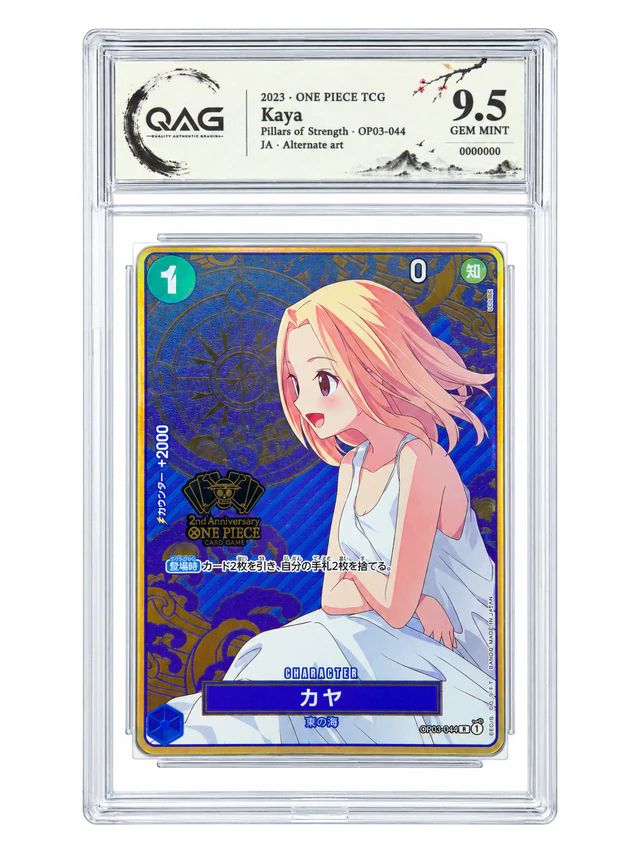
Images from sample certificate 0000000. Choose an area to explore the evidence and what we inspect.
These images document one sample card; they are not visual benchmarks for every grade. Displayed subgrades are the reviewed, published results.
Change a score.
See what changes.
Explore eight front and back scores to see how the weakest area shapes the overall grade.
Learning tool · Not an actual card assessment
AreaFrontBackPaired
Centering
Corners
Edges
Surface
Try a preset
Pairing example · Centering
(10 + 9.5) ÷ 2 = 9.75 → 9.5
Average both sides, then round down to a half point.
The rules behind the numbers
75% of the lowest subgrade + 25% of the four-subgrade mean.
Cap at the lowest subgrade + 1, and at Centering.
Round down to a half point, with all eight side scores present.
This tool explains the calculation only. A published certificate requires QAG review of the images, scores, and findings.
How close to 50/50 is each Centering score?
Measure the printed frame against the cut edge. Normalize left/right and top/bottom separately to 100%, then compare both axes with 50/50.
10.0
Both axes are within 2.5 percentage points of 50. A 52.5/47.5 split is inside this tolerance; it does not mean the margins are exactly equal.
9.5
One axis stays within 2.5 percentage points of 50; the other is more than 2.5 and at most 5 away. Example: 50/50 and 55/45.
9.0
Both axes are more than 2.5 and at most 5 percentage points from 50. Example: 55/45 on both axes.
Below 9
Use the more imbalanced axis: 60/40 → 8, 65/35 → 7, 70/30 → 6, 75/25 → 5, 80/20 → 4, 85/15 → 3, 90/10 → 2 and 100/0 → 1. Intermediate values round to the nearest half point, capped at 8.5 in this band.
Displayed ratios and rounded scores are different steps
The Cert displays ratios to two decimal places; threshold comparisons use the underlying unrounded values. A displayed ratio near a boundary is insufficient to reconstruct its score. For nearest-half rounding below 9, an exact midpoint uses ties-to-even: for example, 8.25 → 8.0.
Once front and back are scored, average them and round down to a half point as shown above. Final results require review; an unmeasured axis must not be filled with 50/50. This table explains Centering, not KAMI eligibility or Surface defect severity.
Card condition levels
Every level, from 1 to 10 in half-point steps. A grade of 10 has two distinct tiers.
The highest QAG distinction
10
KAMI
QAG’s highest tier. Every condition below must be met.
Overall 10, with all four subgrades at 10 on both front and back.
Measured 50/50 centering horizontally and vertically on both sides.
No confirmed defects, with finalized evidence reviewed before publication.
QAG10KAMI
10
Pristine
An overall grade of 10 that does not meet every KAMI condition.
The number 10 alone does not mean KAMI. Read the tier printed on the label and certificate.
10
KAMI
QAG’s highest tier: virtually flawless under detailed review and clear of all KAMI gates.
10
Pristine
A 10 with premium condition that does not meet one or more KAMI conditions.
9.5
Gem Mint
Premium condition with only extremely minor issues found under close inspection.
9
Mint
Sharp and clean, with minor issues that do not undermine the overall presentation.
8.5
Near Mint–Mint+
Very strong condition with minor manufacturing or handling issues.
8
Near Mint–Mint
Very good condition with light evidence of handling visible on close review.
7.5
Near Mint+
Several light signs of wear, while the overall presentation remains strong.
7
Near Mint
More visible wear, but the card still presents well.
6.5
Excellent–Mint+
A moderate small flaw or several minor flaws are visible.
6
Excellent–Mint
Manufacturing or handling wear is clearly more apparent.
5.5
Excellent+
Multiple issues are present, while the card remains presentable.
5
Excellent
Visible wear and surface or edge issues affect the presentation.
4.5
Very Good–Excellent+
Several issues combine and begin to affect eye appeal.
4
Very Good–Excellent
More advanced wear is present, including possible light pressure marks or creases.
3.5
Very Good+
A significant flaw is present, but the card remains clearly legible and viewable.
3
Very Good
Multiple visible flaws materially affect the overall presentation.
2.5
Good+
Some heavy damage is present, such as a clear crease or advanced wear.
2
Good
Multiple heavy creases or substantial wear are present.
1.5
Fair
One or more severe defects are present.
1
Poor
Heavy damage substantially affects the card’s structure or presentation.
These condition names describe QAG’s scale and do not promise an equivalent grade from another company.
Every grade deserves evidence.
QAG reviews the images, scores, and report before publication. Explore a full sample certificate or start your submission.